Text
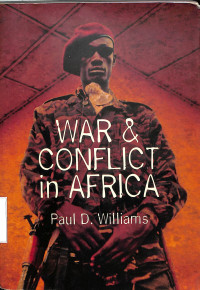
War & Conflict in Africa
In this comprehensive study of contemporary African armed violence, Paul D. Williams examines the proliferation of wars and conflicts across sub-Saharan Africa after the end of the Cold War, and seeks to explain not only how many and what kinds of conflicts occur, but also why they happen and what is (or is not) done about them. The book offers a comparative assessment of hundreds of conflicts from the early 1990s onward, exploring their political contexts, core “ingredients”, and international responses.
In Part I: Contexts, Williams maps the terrain of Africa’s wars by reviewing attempts to measure conflict incidence and casualties, and by sketching the structural and conceptual environment in which violence has proliferated.
In Part II: Ingredients, he interrogates five contested factors often cited in the literature: neopatrimonial governance systems, natural and human resources, sovereignty and self-determination, ethnicity, and religion. He argues that none of these variables alone suffices as a universal cause of war; rather, conflicts emerge from particular combinations and from political choices.
In Part III: Responses, the focus shifts to external and institutional reactions: building regional architectures for peace and security; peacemaking diplomacy; peace-operations and peace-keeping; and development-oriented interventions. Williams critically assesses their achievements and limitations, emphasizing that durable peace hinges not simply on external tools but on internal political reforms.
Ultimately, Williams contends that governance and political agency—rather than structural determinism such as “resources always cause war” or “ethnicity always causes conflict”—are central. He calls for nuanced, context-sensitive inquiry and policy-making, emphasizing that simplistic, single-factor explanations are inadequate for capturing the complexity of war in Africa.
Ketersediaan
Informasi Detail
- No. Panggil
-
900-Will-w
- Penerbit
- CAMBRIDGE : Polity ress., 2011
- Deskripsi Fisik
-
320 hal, 17 x 24 cm
- Bahasa
-
English
- ISBN/ISSN
-
978-0-7456-4544-5
- Tipe Isi
-
Text
- Tipe Media
-
Book
- Subjek
-
-
- Daftar isi
Informasi Lainnya
- Daftar Isi
-
Bab I Contexts
Bab II Ingredient
Bab III Responses
Versi lain/terkait
Tidak tersedia versi lain
 Karya Umum
  Filsafat
  Agama
Agama  Ilmu-ilmu Sosial
  Bahasa
  Ilmu-ilmu Murni
  Ilmu-ilmu Terapan
  Kesenian, Hiburan, dan Olahraga
  Kesusastraan
  Geografi dan Sejarah