Text
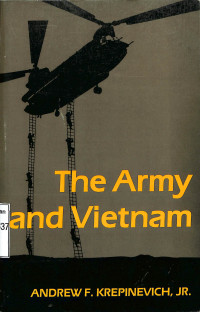
The Army And Vietnam
The Army and Vietnam offers a powerful and critical analysis of the United States Army’s failure during the Vietnam War. Andrew F. Krepinevich argues that the defeat was not primarily due to tactical mistakes or lack of resources, but rather to the institutional culture and doctrinal mindset of the U.S. Army itself. The Army approached Vietnam as if it were a conventional war, when in reality it required a fundamentally different approach—one rooted in counterinsurgency strategy.
The central argument of the book is that the Army’s organizational culture, developed and reinforced since World War II, was geared toward large-scale, high-intensity conventional warfare, emphasizing firepower, mobility, and decisive battles. This orientation made it incapable of effectively responding to the guerrilla warfare and political dimensions of the Vietnam conflict.
Key points discussed include:
Doctrinal rigidity: The U.S. Army applied conventional battle tactics to an unconventional war, focusing on “search and destroy” missions rather than securing the population and undermining the Viet Cong’s political control.
Institutional bias: Military training, evaluation, and promotion systems rewarded battlefield success measured by body counts and territorial control, not by political stability or popular support.
Neglected counterinsurgency strategy: Krepinevich highlights that successful “pacification” efforts—focused on protecting civilians and building local governance—were limited and underappreciated by military leadership.
Cultural resistance to change: Deep-seated beliefs about what constitutes a “real war” prevented the Army from adapting its doctrine, even when faced with mounting evidence that conventional tactics were failing.
Strategic lessons: The author calls for a transformation in military thinking to prepare for future low-intensity conflicts and insurgencies, arguing that organizational culture must evolve alongside technological and geopolitical changes.
In conclusion, Krepinevich demonstrates that the U.S. Army lost in Vietnam not on the battlefield, but in the realm of ideas and doctrine. Its inability to understand the political nature of the war and to adapt its strategy led to a prolonged and ultimately futile conflict.
Ketersediaan
Informasi Detail
- No. Panggil
-
959.704-33-73-Kre-a
- Penerbit
- London : Johns Hopkins University Press., 1986
- Deskripsi Fisik
-
-
- Bahasa
-
English
- ISBN/ISSN
-
-
- Tipe Isi
-
Text
- Tipe Media
-
-
- Subjek
-
-
- Daftar isi
Informasi Lainnya
- Daftar Isi
-
The Advisory Years, 1954-1965 Years of Intervention, 1965-1968 Years of Withdrawal, 1968-1973
Versi lain/terkait
Tidak tersedia versi lain
 Karya Umum
  Filsafat
  Agama
Agama  Ilmu-ilmu Sosial
  Bahasa
  Ilmu-ilmu Murni
  Ilmu-ilmu Terapan
  Kesenian, Hiburan, dan Olahraga
  Kesusastraan
  Geografi dan Sejarah